

Nutrition
Overview
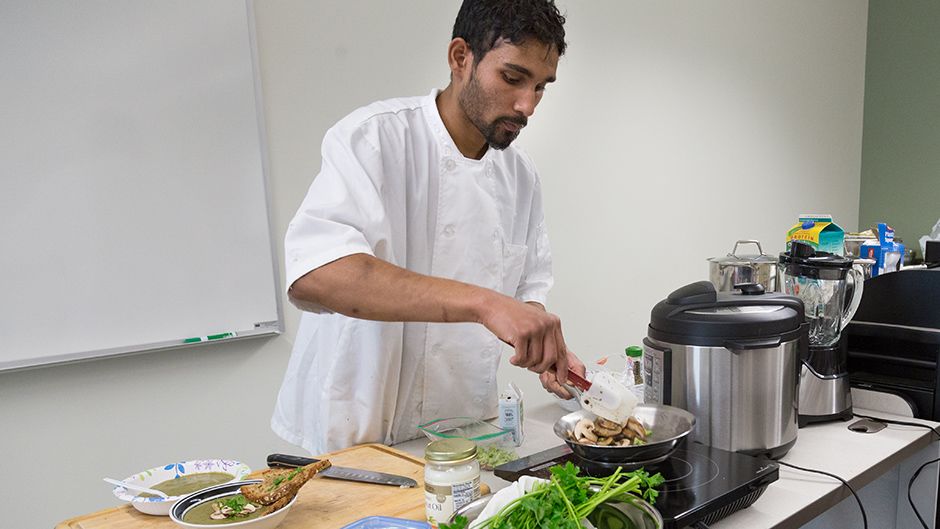
CRC's Nutrition department offers an associate's degree program that is challenging, accessible, and rewarding. The program provides opportunities to master the knowledge and skills required for transfer to a didactic program in dietetics or a four-year degree in nutrition and foods.
Program Maps
A.A./A.S. Degrees
AA-T/AS-T Transfer Degrees
Certificates
- Dean Kris Hubbard
- Department Chair Serena Fuller
- Career and Academic Community Health and Human Services
- Phone (916) 691-7296
- Email hubbark@crc.losrios.edu
Associate Degrees for Transfer
A.S.-T. in Nutrition and Dietetics
The Associate in Science in Nutrition and Dietetics for Transfer degree provides students with a major that fulfills the general requirements of the California State University for transfer to baccalaureate degree programs in nutrition and dietetics. Students with this degree will receive priority admission with junior status to the California State University system. The Associate in Science in Nutrition and Dietetics for Transfer is comprised of lower division coursework typically required by CSU institutions.
Students must complete the following Associate Degree for Transfer (ADT) requirements:
(1) Completion of 60 semester units or 90 quarter units that are eligible for transfer to the California State University, including both of the following:
(A) The California General Education Transfer Curriculum (Cal-GETC).
(B) A minimum of 18 semester units or 27 quarter units in a major or area of emphasis, as determined by the community college district.
(2) Obtainment of a minimum grade point average of 2.0.
ADTs also require that students must earn a “C†or better in all courses required for the major or area of emphasis. A “P†(Pass) grade is also an acceptable grade for courses in the major if the course is taken on a Pass/No Pass basis.
Upon successful completion of the Associate in Science in Nutrition and Dietetics for Transfer degree requirements, students will be guaranteed admission to the CSU system with junior status and will not have to repeat lower division coursework.
Each California State University may have slightly different requirements for transfer so it is critical for students to work with their counselors to develop individual academic plans.
Catalog Date: August 1, 2026
Degree Requirements
| Course Code | Course Title | Units |
|---|---|---|
| Core: | ||
| NUTRI 300 | Nutrition | 3 |
| PSYC C1000 | Introduction to Psychology | 3 |
| CHEM 400 | General Chemistry I (5) | 10 |
| and CHEM 401 | General Chemistry II (5) | |
| BIOL 440 | General Microbiology | 4 |
| List A: | ||
| A minimum of 3 units from the following: | 3 | |
| CHEM 420 | Organic Chemistry I (5) | |
| BIOL 430 | Anatomy and Physiology (5) | |
| and BIOL 431 | Anatomy and Physiology (5) | |
| STAT C1000E | Introduction to Statistics (4) | |
| or STAT C1000H | Introduction to Statistics - Honors (4) | |
| or ECON 310 | Statistics for Business and Economics (3) | |
| or PSYC 330 | Introductory Statistics for the Behavioral Sciences (3) | |
| List B: | ||
| A minimum of 3 units from the following: | 3 | |
| ACCT 341 | Computerized Accounting (3) | |
| BUS 340 | Business Law (3) | |
| CAM 301 | Food Theory and Preparation (4) | |
| CAM 306 | Culinary Sanitation & Safety (2) | |
| FCS 324 | Human Development: A Life Span (3) | |
| NUTRI 310 | Cultural Foods of the World (3) | |
| SOC 300 | Introductory Sociology (3) | |
| Total Units: | 26 | |
The Associate in Science in Nutrition and Dietetics for Transfer (AS-T) degree may be obtained by completion of 60 transferable, semester units with a minimum 2.0 GPA, including (a) the major or area of emphasis described in the Required Program, and (b) the California General Education Transfer Curriculum (Cal-GETC) Requirement.
Enrollment Eligibility
To be eligible for enrollment in the program, the student must meet the following criteria:
- Have access to the Internet
- Be familiar with word processing, PowerPoint, retrieving and attaching electronic documents and using the world wide web
- Have self-discipline, motivation, and the ability to complete required assignments on schedule.
Enrollment Process
Eligible students are selected for the program according to the following steps:
- Admission to the college
- Contact CRC Nutrition and Foods Program Counselor regarding the specific transferrable requirements for the individual universities.
Student Learning Outcomes
Upon completion of this program, the student will be able to:
- PSLO 1: Explain the principles of nutrition and its effect on health
- PSLO 2: Demonstrate a fundamental understanding of health behaviors on nutritional and health status
Career Information
Upon successful completion of a baccalaureate degree in nutrition or dietetics include positions as dieticians, nutritionists and dietetic technicians in hospitals/nursing homes, school food services, other health related facilities, college food service, industry food service, restaurants, public health agencies, nutrition programs, WIC programs, Meals on Wheels, health clubs, weight management clinics, community wellness centers, food companies, contract food management companies, and food distribution companies.
Associate Degrees
A.S. in Nutrition and Foods
CRC’s Department of Nutrition and Foods offers an Associate's Degree Program that is challenging, accessible, and rewarding. The program provides opportunities to master the knowledge and skills required for transfer to a didactic program in dietetics or a four-year degree in nutrition and foods.
Highlights include:
* Online nutrition courses
* Sustainable nutrition course offerings
* Collaborations between CRC Culinary and Agriculture disciplines
Note to Transfer Students:
If you are interested in transferring to a four-year college or university to pursue a Bachelor’s degree in this major, it is critical that you meet with a CRC counselor to select and plan the courses for your major. Schools vary widely in terms of the required preparation. The courses that CRC requires for an Associate’s degree in this major may be different from the requirements needed for the Bachelor’s degree.
Catalog Date: August 1, 2026
Degree Requirements
| Course Code | Course Title | Units |
|---|---|---|
| First Year (Fall): | ||
| NUTRI 300 | Nutrition | 3 |
| First Year (Spring): | ||
| NUTRI 310 | Cultural Foods of the World (3) | 3 |
| CAM 306 | Culinary Sanitation & Safety | 2 |
| Second Year (Fall): | ||
| NUTRI 350 | Community Nutrition | 3 |
| First Year (Fall): | ||
| PSYC C1000 | Introduction to Psychology | 3 |
| First Year (Spring): | ||
| CHEM 305 | Introduction to Chemistry (5) | 51 |
| or CHEM 400 | General Chemistry I (5) | |
| First Year (Spring): | ||
| NUTRI 370 | Food Service Management (3) | 3 |
| First Year (Fall): | ||
| NUTRI 322 | Nutrition Issues Throughout Life | 3 |
| Second Year (Fall): | ||
| BIOL C1001 | Introduction to Biology (3) | 4 |
| and BIOL C1001L | Introduction to Biology Lab (1) | |
| Second Year (Spring): | ||
| BIOL 102 | Essentials of Human Anatomy and Physiology (4) | 4 - 52 |
| or BIOL 430 | Anatomy and Physiology (5) | |
| First Year (Spring): | ||
| NUTRI 331 | Plant-Based Food Principles and Preparation | 3 |
| Second Year (Spring): | ||
| NUTRI 340 | Nutrition and Metabolism | 3 |
| Total Units: | 39 - 40 | |
1CHEM 305, 400 transferable to CSUS Didactic Program
2BIOL 430 transferable to CSUS Didactic Program
The Nutrition and Foods Associate in Science (A.S.) degree may be obtained by completion of the required program, and either (a) the Local General Education Pattern or (b) the California General Education Transfer Curriculum (Cal-GETC), plus sufficient electives for a total of at least 60 units. See CRC graduation requirements.
Student Learning Outcomes
Upon completion of this program, the student will be able to:
- PSLO 1: Demonstrate independent learning and effective communication skills
- PSLO 2: Explain the principles of nutrition and its effect on health
- PSLO 3: Demonstrate a fundamental understanding of health behaviors on nutritional and health status
- PSLO 4: Demonstrate a fundamental understanding of food service management function
- PSLO 5: Compare the effectiveness of various management styles
- PSLO 6: Interpret current nutrition research
Career Information
Hospitals/nursing homes, school food services, other health related facilities, college food service, industry, restaurant, public health agencies, nutrition program, WIC programs, Meals on Wheels, health clubs, weight management clinic, community wellness centers, food companies, contract food management companies, food distribution companies. Some career options may require more than two years of college study. Classes beyond the associate degree may be required to fulfill some career options or for preparation for transfer to a university program.
Certificates of Achievement
Nutrition and Foods, Community Nutrition Certificate
This certificate advances student's understanding of the interaction between nutrition and health, keeping food safe in communities, and nutrition as a social justice issue. The focus is on community well-being through a nutrition and food lens. Students will gain knowledge in the nutrition needs of individuals throughout the lifecycle, cultural influences on food intake, community programs and policies that address nutrition-related issues, and the safe handling of food. After completing the classes for this certificate, students may apply credits toward CRC's Nutrition and Foods associate's degree program. Students earning this certificate are not qualified to practice medical nutrition therapy.
Catalog Date: August 1, 2026
Certificate Requirements
| Course Code | Course Title | Units |
|---|---|---|
| NUTRI 300 | Nutrition | 3 |
| NUTRI 310 | Cultural Foods of the World | 3 |
| NUTRI 322 | Nutrition Issues Throughout Life | 3 |
| NUTRI 350 | Community Nutrition | 3 |
| NUTRI 370 | Food Service Management | 3 |
| CAM 306 | Culinary Sanitation & Safety | 2 |
| Total Units: | 17 |
Enrollment Eligibility
To be eligible for enrollment in the program, the student must meet the following criteria:
- Have consistent access to wifi to engage with online course management system and communication.
- Be familiar with retrieving and attaching electronic documents and using the Internet.
- Exhibit time management and self motivation in an online learning environment.
Student Learning Outcomes
Upon completion of this program, the student will be able to:
- PSLO 1: Exhibit the specialized communication skills required for work in community nutrition settings
- PSLO 2: Explain the principles of nutrition and its effect on health
- PSLO 3: Demonstrate a fundamental understanding of health behaviors on nutritional and health status
Career Information
Upon further academic study, students would be qualified for positions in hospitals/nursing homes, school food services, other health related facilities, college food service, industry, restaurant, public health agencies, nutrition programs, WIC (Women, Infants & Children) programs, Elderly Nutrition programs, health clubs, weight management clinics, community wellness centers, food companies, contract food management companies, food distribution companies. These career options may require more than the certificate and two years of college study. Classes beyond the associate degree may be required to fulfill some career options or for preparation for transfer to a university program.
Regenerative Foodways Certificate
The Regenerative Foodways Certificate brings the intersection of food, health, and environment into the classroom. The courses provide hands-on learning in the current fields of sustainable nutrition and regenerative agriculture. Students will explore the benefits of plant-focused eating patterns for both individuals and the planet, learn how to create nourishing meals centered around plants, and discover farming methods that promote fairness and sustainability in food production.
Contact the CRC Nutrition and Foods and/or Horticulture, and/or Ag Counselor regarding transferable courses.
Catalog Date: August 1, 2026
Certificate Requirements
| Course Code | Course Title | Units |
|---|---|---|
| NUTRI 303 | Plant-Based Nutrition | 3 |
| NUTRI 331 | Plant-Based Food Principles and Preparation | 3 |
| HORT 313 | Sustainable Agriculture | 3 |
| Total Units: | 9 |
Student Learning Outcomes
Upon completion of this program, the student will be able to:
- PSLO 1: Demonstrate independent learning and effective communication skills.
- Demonstrate responsibility for personal action and choices.
- Communicate effectively both orally and in writing.
- PSLO 2: Explain the principles of nutrition and its effect on health.
- Relate the dietary causes of chronic diseases.
- Evaluate the role of plant-based foods on health and the environment.
- PSLO 3: Demonstrate a fundamental understanding of health behaviors on nutritional and health status.
- Schematize the effects of personal food choice on health, the environment and public policy.
- PSLO 4: Basic and advanced plant science/horticulture skills development and improvement.
- Demonstrate and apply the theories of sustainable and organic agriculture.
- Demonstrate a fundamental understanding of soils, soil development, soil building and preparation and sustainable soil management.
- Demonstrate a fundamental understanding of hydraulics and irrigation design, installation, and water management principles and practices.
- Create agriculture design concepts based on sound, sustainable soil management, water conservation, construction and maintenance, and integrated pest management best practices.
- PSLO 5: Effectively and accurately prepare and analyze raw ingredients and prepared foods.
- Evaluate food through sensory evaluation of texture, taste, color, presentation, smell and umami.
- Identify optimal cooking procedures/heat transfer to maximize nutrient content as well as the quality of the ingredients and dish as a whole.
- Analyze quality defects in cooked products and specify possible errors in techniques or ingredient selection.
- PSLO 6: Implement proper sanitary and safety techniques.
- Demonstrate appropriate food handling and sanitary techniques.
- Utilize kitchen tools/equipment appropriately.
Career Information
In restaurants, food service facilities, farms, urban farms, sustainable/organic farms, school garden, health education. Some of these career options may require more than the certificate and two years of college study. Classes beyond the associate degree may be required to fulfill some career options or for preparation for transfer to a university program.
Nutrition (NUTRI) Courses
NUTRI 299 Experimental Offering in Nutrition and Foods
- Units:0.5 - 4
- Prerequisite:None.
- Catalog Date:August 1, 2026
This is the experimental courses description.
NUTRI 300 Nutrition
- Units:3
- Hours:54 hours LEC
- Prerequisite:None.
- Transferable:CSU; UC
- General Education:Local GE L5; Local GE L7B
- C-ID:C-ID NUTR 110
- Catalog Date:August 1, 2026
This course focuses on an introduction to nutrition science, focusing on experimental methodology, hypothesis testing, and systematic investigation used in biological sciences. Students will explore scientific inquiry—from observation and hypothesis development to data collection and evidence-based reasoning to examine foundational principles of nutrition science. Through activities students will understand the interdependency of biological and physical sciences and the limitations and ethical implications of scientific advancements. The course equips students to critically engage with the role of science in society.
Student Learning Outcomes
Upon completion of this course, the student will be able to:
- SLO #1: Explain scientific theories, concepts, data, and limitations used in nutrition science.
- Explain and analyze scientific principles and the processes of scientific discovery in nutrigenomics, microbiota, human metabolism, and nutrition science.
- Diagram the sequential steps of the scientific method outlining the methods scientists use to explore nutritional phenomenon, including observation, hypothesis development, measurement and data collection, experimentation, evaluation of evidence and the use of mathematical analysis.
- SLO #2: Examine evidence-based conclusions and form reasoned opinions about nutrition science-related matters of personal, public, and ethical concern in human living systems.
- Distinguish between different types of research studies and evaluate the quality and applicability of evidence, considering the principles of experimental methodology and systematic questioning, understanding the power and limitations of science.
- Locate, interpret, evaluate, and use peer-reviewed studies and literature to make ethical, evidence-based health-related decisions.
- Conduct a peer review process in formulating a critical analysis of a nutrient-related health outcome using methodology of scientific inquiry.
- SLO #3: Connect chemical principles to nutrition and physiological processes, illustrating their connection.
- Explain the basic structure of molecules and chemical bonding in relation to nutrients.
- Describe the hierarchical levels of structural organization within the human body, ranging from the fundamental building blocks of atoms, chemical bonding, and molecules to the complex interactions of organ systems.
- Correlate the steps of photosynthesis in glucose production to energy metabolism in the human body.
- Explain the chemical structure, chemical bonding, and biological functions of macronutrients; and list major food sources for each.
- Identify the elements of basic anatomy and physiology and explain the body’s mechanical, enzymatic, and hormonal aspects of digestion, absorption, metabolism, and excretion of nutrients.
- Identify, determine, and analyze metabolic processes, pathways, and utilization of macro- and micronutrients from a cellular level to accompanying organ systems.
- Explain the relationship between molecular structures and the metabolic pathways of macro- and micronutrients in the human body.
- SLO #4: Examine the principles underlying the relationship of macro- and micronutrients and optimal health and fitness, nutrient deficiency or excess, and disease in human living systems.
- Identify the energy systems in relation to fuel utilization for physical activity describing how duration and intensity impact the types of fuel used for physical activity during aerobic and anaerobic metabolism.
- Summarize the use of carbohydrates, fats, proteins, minerals, vitamins, and water in building and maintenance of tissue.
- SLO #5: Use information technologies to choose and select evidence-based nutrition guidelines and protocols in analyzing the nutrition adequacy of diets and provide recommendations to meet guidelines based on age, gender, fitness, and health conditions.
- Analyze the nutrient adequacy of a dietary intake by using nutrition analysis technology.
NUTRI 303 Plant-Based Nutrition
- Units:3
- Hours:54 hours LEC
- Prerequisite:None.
- Transferable:CSU
- General Education:Local GE L7B
- Catalog Date:August 1, 2026
This course studies the science of plant-based nutrition and its application to health promotion, chronic disease reduction and the sustainability of the environment. It examines the sources and functions of micro- and macronutrients in plant foods and how the body digests, absorbs, transports and stores them. Emphasis is placed on the health implications associated with the standard American dietary intake, phytonutrient intake, whole foods/plant foods consumption, the impact of processing, and consequences of under and overconsumption. The course will also include topics on how plant-based nutrition significantly reduces the ecological footprint, how food choice can influence public policy, weight loss, food safety, and the diet-disease relationship, among others. An evaluation of personal dietary habits using current dietary guidelines and nutritional assessment methods will be completed to help students assess their own plant-based nutritional health.
Student Learning Outcomes
Upon completion of this course, the student will be able to:
- SLO 1: Demonstrate independent learning and effective communication skills.
- Demonstrate responsibility for personal actions and choices.
- Communicate effectively both orally and in writing.
- SLO 2: Explain the principles of nutrition and its effect on health.
- Relate the dietary causes of chronic diseases.
- Evaluate the role of plant-based foods on individual health and the environment.
- SLO 3: Demonstrate a fundamental understanding of health behaviors on nutritional and health status.
- Schematize the effects of personal food choice on health, the environment and public policy.
NUTRI 310 Cultural Foods of the World
- Units:3
- Hours:54 hours LEC
- Prerequisite:None.
- Advisory:LIBR 318
- Transferable:CSU; UC
- General Education:Local GE L4; Cal-GETC Area 4
- Catalog Date:August 1, 2026
This course compares various western and non-western culture food customs and patterns including their social, religious, economic and aesthetic significance. The nutritional status of various cultures as it relates to geographic agricultural and socioeconomic factors will be explored. Ethnocentrism, gender-related stereotypes, and racism as they relate to the availability, distribution, and preparation of food throughout the world will also be compared.
Student Learning Outcomes
Upon completion of this course, the student will be able to:
- SLO 1: Demonstrate independent learning and effective communication skills
- demonstrate independent learning by attending or logging in to class regularly
- utilize time management effectively and prioritizes tasks to meet deadline
- demonstrate effective oral and written communication
- SLO 2: Demonstrate fundamental understanding of health behaviors on nutritional and health status
- analyze ethnicity, ethnocentrism, and racism and their impact on American food habits
- analyze the impact of food-related stereotypes
- compare traditional food habits of other cultures with contemporary food habits of Americans
- explain the sociocultural and ethnic food consumption issues and trends
- explain the influence of socioeconomic, cultural, and psychological factors on food and nutrition behavior
- examine the significant aspects of various cultures, their contributions, and influences on American food preference and consumption
- describe the traditional food habits, common foods, meal patterns, special occasion foods, food taboos, and the role of food from various regions of the world
- analyze similarities and differences in the nutritional contributions from comparative ethnic foods
- list the common foods in each culture studied
- identify food patterns as related to religious practices, cultural customs, psychological and family structures, and health beliefs
- analyze the distribution and availability of food based on ethnocentrism, gender-related issues and racism
- demonstrate personal methods of cultural tolerance by examining various cultures
NUTRI 322 Nutrition Issues Throughout Life
- Units:3
- Hours:54 hours LEC
- Prerequisite:NUTRI 300 with a grade of "C" or better
- Advisory:LIBR 318
- Transferable:CSU
- General Education:Local GE L7B
- Catalog Date:August 1, 2026
This course is a study of the nutritive needs of persons at various stages of the lifecycle with emphasis on special periods such as pregnancy, preschool, adolescence and aging. This course may be helpful for Kinesiology and Early Childhood Education students as well as those working with people in social agencies, such as nursing and gerontology, seeking an understanding of the nutritional changes and requirements through the different stages of life.
Student Learning Outcomes
Upon completion of this course, the student will be able to:
- SLO 1: Demonstrate independent learning and effective communication skills
- Demonstrate independent learning by attending or logging in to class regularly.
- Utilize time management effectively and prioritizes tasks to meet deadlines.
- Demonstrate effective oral and in written communication.
- SLO 2: Explain the principles of nutrition and its effect on health
- Analyze the effect of nutrition on the outcome of pregnancy for both the mother and the child.
- Examine the nutrition needs of low and high-risk pregnancies.
- Evaluate the nutrient needs of healthy persons at various stages of life.
- Examine how nutrient needs can be satisfied under normal conditions at each stage of development.
- Inspect the nutrition support programs and the role of the nutrition professional in promoting nutrition and health.
- Distinguish the role of nutrition on growth and development as well as health in children, pregnancy, and elderly.
- SLO 3: Demonstrate a fundamental understanding of health behaviors on nutritional and health status
- Inspect the factors involved in the development of healthy food and lifestyle habits.
- Formulate a nutritional care plan to promote health during pregnancy, lactation, infancy, childhood, adolescence, adulthood, and elderly years.
- SLO 4: Interpret current nutrition research
- Analyze research articles and summarize findings in essays.
NUTRI 331 Plant-Based Food Principles and Preparation
- Units:3
- Hours:36 hours LEC; 54 hours LAB
- Prerequisite:None.
- Advisory:MATH 20 with a grade of "C" or better
- Transferable:CSU
- Catalog Date:August 1, 2026
This course provides a comprehensive study of plant-based food ingredients and the basic principles and techniques involved in plant-based food preparation. Students will examine the factors that influence taste and the changes that occur in foods during preparation. In the laboratory, basic cooking skills and theoretical applications will be emphasized. Additionally, importance is placed on the reasons for recipe procedures and the prevention and correction of cooking failures.
Student Learning Outcomes
Upon completion of this course, the student will be able to:
- SLO 1: Demonstrate independent learning and effective communication skills.
- Demonstrate responsibility for personal actions and choices.
- Communicate effectively both orally and in writing.
- SLO 2: Effectively and accurately prepare and analyze raw ingredients and prepared foods.
- Evaluate food through sensory evaluation of texture, taste, color, presentation, smell.
- Identify optimal cooking procedures/heat transfer to maximize nutrient content as well as the quality of the ingredients and dish as a whole.
- Analyze quality defects in cooked products and specify possible errors in techniques or ingredient selection.
- SLO 3: Implement proper sanitary and safety techniques.
- Demonstrate appropriate food handling and sanitary techniques.
- Utilize kitchen tools/equipment appropriately.
NUTRI 340 Nutrition and Metabolism
- Units:3
- Hours:54 hours LEC
- Prerequisite:NUTRI 300 with a grade of "C" or better
- Advisory:BIOL 102 and LIBR 318
- Transferable:CSU
- Catalog Date:August 1, 2026
This course examines the chemical structure and metabolism of carbohydrates, lipids, and proteins. Emphasis is placed on the biological roles of vitamins and minerals, metabolic pathways and their relation to health and disease. In addition, this course will help the student integrate and apply metabolic knowledge and concepts to contemporary and controversial issues in nutrition.
Student Learning Outcomes
Upon completion of this course, the student will be able to:
- SLO 1: Demonstrate independent learning and effective communication skills.
- Demonstrate independent learning by attending or logging in to class regularly.
- Utilize time management effectively and prioritizes tasks to meet deadlines.
- Demonstrate effective written communication.
- SLO 2: Explain the principles of nutrition and its effect on health
- Analyze the biological role of various nutrients in the body.
- Analyze and examine nutrition and metabolism at the physiological level.
- Relate the deficiency and toxicity conditions to the vitamin and minerals.
- Examine the role and the metabolic processes of the macronutrients.
- Evaluate the type of nutrients and how nutrients are used for energy during various conditions.
- Analyze the role of complementary and alternative nutrition and dietary supplements.
- SLO 3: Interpret current nutrition research.
- Examine the appropriate use and interpretation of the current dietary guidelines and recommendations.
- Integrate scientific knowledge and relate it to current nutrition issues.
- Compose a written essay on a current nutrition issue.
NUTRI 350 Community Nutrition
- Units:3
- Hours:54 hours LEC
- Prerequisite:NUTRI 300 with a grade of "C" or better
- Advisory:NUTRI 340
- Transferable:CSU
- Catalog Date:August 1, 2026
This course studies the theory, concepts, and philosophy affecting nutrition education and services in the community. Students will be introduced to programs, policies, and institutions that influence nutrition services at local, state and national levels throughout the lifespan, with special emphasis on infants and children as well as the elderly. Students will learn about epidemiology and its application in nutrition research and explore examples of how a variety of teaching methods can improve the nutritional status in a community and with various population groups.
Student Learning Outcomes
Upon completion of this course, the student will be able to:
- SLO 1: Demonstrate independent learning and effective communication skills.
- demonstrate independent learning by attending or logging in to class regularly
- utilize time management effectively and prioritizes tasks to meet deadlines
- demonstrate effective oral and written communication
- SLO 2: Demonstrate a fundamental understanding of health behaviors on nutritional and health status
- examine the factors involved in nutrition-related deficiencies
- appraise the public policy role in community nutrition and other health programs
- demonstrate knowledge of educational material development
- demonstrate knowledge of economic and public policy issues related to nutrition, food availability, and nutrition behaviors
- identify educational needs of diverse populations
- analyze general health assessment and application of health promotion and disease prevention
- SLO 3: Interpret current nutrition research
- assess the nutrition-related problems which exist and the services available for helping to prevent or assist those problems in the community
- examine materials and techniques for working in or with various community groups
- demonstrate knowledge of a needs assessment
- demonstrate knowledge of program planning, monitoring, and evaluation
NUTRI 370 Food Service Management
- Units:3
- Hours:54 hours LEC
- Prerequisite:None.
- Transferable:CSU
- Catalog Date:August 1, 2026
The course will study the organization, planning, and control of production for a quantity food service operation. This course also examines the process and importance of food service functions such as leadership, human resource management and employee in-service training, menu planning and pricing, scheduling of staff and production, portion and temperature control, recipe standardization and scaling, basic tenants of food and equipment safety and sanitation, and elements of culinary layout and design.
Student Learning Outcomes
Upon completion of this course, the student will be able to:
- SLO 1: Demonstrate independent learning and effective communication skills.
- Demonstrate independent learning by attending or logging in to class regularly.
- Utilize time management effectively and prioritize tasks to meet deadlines.
- Demonstrate effective communication (orally and/or in writing).
- SLO 2: Demonstrate a fundamental understanding of food service management function.
- Analyze scheduling requirements for food production and staffing efficiently.
- Calculate menu item costs and calculate selling prices.
- Distinguish principles of good menu writing practice.
- Explain methods of controlling portion size.
- Discuss the factors affecting volume and sales mix forecasting.
- Calculate standardize recipes and accurately scale recipes for specific operational needs.
- Calculate quantities of food to order and to produce for specified operations.
- Discuss factors involved in planning efficient facility layout and equipment purchases.
- SLO 3: Compare the effectiveness of various management styles.
- Identify management styles.
NUTRI 495 Independent Studies in Nutrition and Foods
- Units:1 - 3
- Hours:54 - 162 hours LAB
- Prerequisite:None.
- Transferable:CSU
- Catalog Date:August 1, 2026
An independent studies project involves an individual student or small group of students in study, research, or activities beyond the scope of regularly offered courses. See the current catalog section of "Special Studies" for full details of Independent Studies.
Student Learning Outcomes
Upon completion of this course, the student will be able to:
- SLO #1: Actively engage in intellectual inquiry beyond that required in order to pass a course of study (College Wide Learning Outcome – Area 4).
- Discuss and outline a proposal of study (that can be accomplished within one semester term) with a supervising instructor qualified within the discipline.
- Design an independent study (to be completed individually or by collaboration of a small group) to foster special knowledge, skills, and experience that are not available in any one regularly scheduled course.
- Use information resources to gather discipline-specific information.
- SLO #2: Utilize modes of analysis and critical thinking to apply theoretical perspectives and/or concepts in the major discipline of study to significant problems and/or educational activities (College Wide Learning Outcome – Area 3).
- Analyze and apply the knowledge, skills and experience that are involved in the independent study to theoretical perspectives and/or concepts in the major discipline of study.
- Explain the importance of the major discipline of study in the broader picture of society.
- SLO #3: Communicate a complex understanding of content matter of the major discipline of study (College Wide Outcome – Area 3).
- Demonstrate competence in the skills essential to mastery of the major discipline of study that are necessary to accomplish the independent study.
- SLO #4: Identify personal goals and pursue these goals effectively (College Wide Outcome – Area 4).
- Utilize skills from the “academic tool kit†including time management, study skills, etc., to accomplish the independent study within one semester term.
NUTRI 499 Experimental Offering in Nutrition and Foods
- Units:0.5 - 4
- Prerequisite:None.
- Transferable:CSU
- Catalog Date:August 1, 2026
This is the experimental courses description.
Faculty
Check Out Degree Planner
If you're interested in a transfer degree (AA-T or AS-T), then check out Degree Planner, a tool that helps you complete your degree efficiently by mapping out what courses to take and when to take them.
More About the Program
Learn more about the plant-based program, find Nutrition resources, and more.
Career Education
This major is part of CRC's Career Education (CE) Program. Request assistance from Career Education by dropping us a line!
